
 California Highways:
Click here for a key to the symbols used. An explanation of acronyms may be found at the bottom of the page.
 Routing
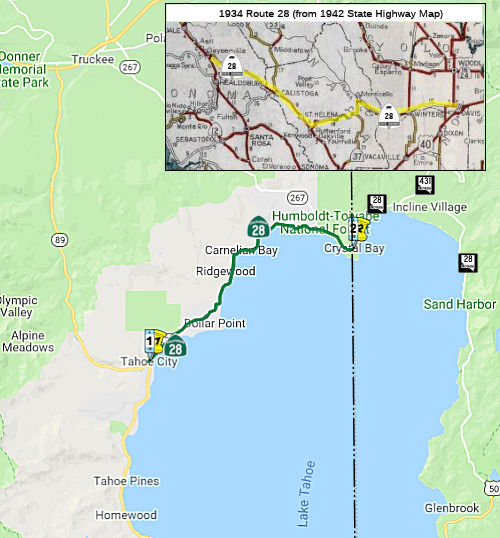 From Route 89 at Tahoe City along the northern boundary of
Lake Tahoe to the Nevada state line at Crystal Bay.
From Route 89 at Tahoe City along the northern boundary of
Lake Tahoe to the Nevada state line at Crystal Bay.
 Post 1964 Signage History
The current definition of Route 28 is unchanged from the 1963 definition.
 Pre 1964 Signage History
 The present-day routing of Route 28 is not the original routing.
In 1934, Route 28 was signed along the route from Jct. Route 1 near Albion
to Jct. US 40 near Davis, vis Sage Canyon. This corresponded to the
following routes:
The present-day routing of Route 28 is not the original routing.
In 1934, Route 28 was signed along the route from Jct. Route 1 near Albion
to Jct. US 40 near Davis, vis Sage Canyon. This corresponded to the
following routes:
In 1952, the original routing for Route 28 was renumbered as Route 128.
The present routing was LRN 39 (defined in 1915), and has been
signed as Route 28 since 1952. Prior to 1952, the route was unsigned. The
Route 28 designation permitted the route along the north shore of Lake
Tahoe between Tahoe City and the California-Nevada boundary to join Nevada
Sign Route 28 at the state line.
 Status
This route continues into Nevada as Nevada 28.
Fanny Bridge Project (Jct Route 89/Route 28) (~ PLA T8.542)
 It was also reported in September 2011 about plans to reconstruct the Fanny Bridge. The bridge
was constructed in 1920 and spans the Truckee River, Lake Tahoe's sole
outlet, near the at-times very congested pedestrian intersection at the
Wye intersection in Tahoe City. The project would rehabilitate Fanny
Bridge, while simultaneously addressing traffic congestion. Preliminary
plans feature four alternatives. Initially, the preferred option calls for
construction of a four-lane bridge to span the Truckee River farther west
from the current Fanny Bridge location. The bridge would be part of a new
road that would serve as the main ingress/egress route connecting Route 89
and Route 28. Roundabouts also would be installed at each intersection.
Meanwhile, Fanny Bridge's structural deficiencies will be addressed, and
the remaining stretch of Route 89 from the Wye to the intersection of the
newly built road will be transformed into a local neighborhood street,
with a variety of traffic calming features designed to dissuade motorists
from using the path as a primary means of travel. The other three
alternatives include changing the existing Route 89 just south of Fanny
Bridge into a pedestrian/bike trail; installing a cul-de-sac at the end of
that street; or conducting the project without roundabouts, respectively.
Planning level cost estimates call for a $13-18 million investment. The
project is slated to continue to solicit community input and feedback
throughout 2011 and develop a final design by 2012. Construction is
tentatively scheduled to commence in 2014.
It was also reported in September 2011 about plans to reconstruct the Fanny Bridge. The bridge
was constructed in 1920 and spans the Truckee River, Lake Tahoe's sole
outlet, near the at-times very congested pedestrian intersection at the
Wye intersection in Tahoe City. The project would rehabilitate Fanny
Bridge, while simultaneously addressing traffic congestion. Preliminary
plans feature four alternatives. Initially, the preferred option calls for
construction of a four-lane bridge to span the Truckee River farther west
from the current Fanny Bridge location. The bridge would be part of a new
road that would serve as the main ingress/egress route connecting Route 89
and Route 28. Roundabouts also would be installed at each intersection.
Meanwhile, Fanny Bridge's structural deficiencies will be addressed, and
the remaining stretch of Route 89 from the Wye to the intersection of the
newly built road will be transformed into a local neighborhood street,
with a variety of traffic calming features designed to dissuade motorists
from using the path as a primary means of travel. The other three
alternatives include changing the existing Route 89 just south of Fanny
Bridge into a pedestrian/bike trail; installing a cul-de-sac at the end of
that street; or conducting the project without roundabouts, respectively.
Planning level cost estimates call for a $13-18 million investment. The
project is slated to continue to solicit community input and feedback
throughout 2011 and develop a final design by 2012. Construction is
tentatively scheduled to commence in 2014.
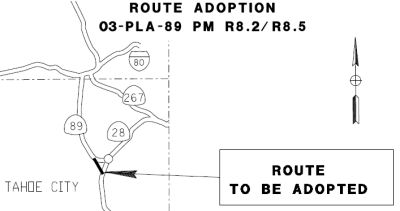
In August 2016, the CTC approved for future consideration of funding a project that realigns a segment of Route 89 with a replacement bridge and various other improvements including a roadway section replacement, pedestrian and bicycle improvements, roundabouts, and a complete streets element to address traffic, bicycle and pedestrian congestion (03-PLA-089 R8.2/R8.5). On April 10, 2015, the TDD adopted the FEIR for State Route 89 / Fanny Bridge Community Revitalization Project under CEQA. On July 15, 2016, the TTD confirmed that the FEIR remains valid and that there are no new identified impacts requiring mitigation since adoption. The TTD also confirmed that the preferred alternative set forth in the final environmental document is consistent with the Project scope of the work programmed by the Commission. The Project is estimated to cost $38,877,000 and is fully funded through construction with Federal Land Access Program (FLAP) Funds ($30,620,000), Active Transportation Program Funds ($4,900,000) and Local Funds ($3,357,000). Construction is estimated to begin in Fiscal Year 2016/17.
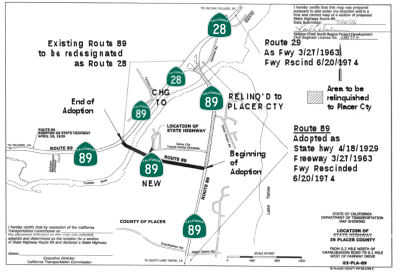 At the same meeting, the CTC also approved Federal
Highway Administration’s Central Federal Lands Highway Division
(CFLHD) plans, in conjunction with Tahoe Transportation District (TTD), to
construct a new alignment for portion of Route 89 near Tahoe City through
United States Forest Service (USFS) property. This new alignment will
better serve the west shore communities of Lake Tahoe by providing an
option for the traveling public as they approach Tahoe City from the south
and from the west. The purpose of the route adoption is to improve safety
and operations of the existing Route 89/Route 28 intersection, improve
multimodal access with the creation of “complete streets”
elements, address long term bridge integrity by replacing the aged Fanny
Bridge, and contribute to economic revitalization by enhancing motorized
and non-motorized business access and safety, including delivery of goods
and services. This project brings about the highest and best beneficial
uses of USFS land and its associated modes of travel. The adopted route
will serve as a parallel route for the traveling public entering or
exiting the hub of Tahoe City. Route 89 serves the west shore communities
of Lake Tahoe, crosses the Truckee River at Fanny Bridge and connects to
Route 28 in Tahoe City, also known as the WYE intersection, before
continuing to the town of Truckee, California. Approaching the WYE
intersection from all three directions, this two-lane conventional highway
has historic congestion during the summer peak season with an unacceptable
Level of Service (LOS) “F”. The urban context of the WYE
intersection in Tahoe City adds to the congestion. During emergency
response to fire, police, or ambulatory calls, there is delay for
emergency crews to clear the WYE intersection. The physical and
environmental setting severely constrains any lane addition, or bridge
widening options to mitigate for the LOS “F”. The current
single route over the Truckee River has proven to be inadequate given the
aforementioned constraints. Bicycle and pedestrian activity are very close
to travel lanes on and around Fanny Bridge. Safety risks to pedestrian,
bicycle, and motorists result from inadequate multi-modal infrastructure
related to discontinuous bicycle paths, and the absence of pedestrian
facilities, compounded with heavy volumes of vehicular traffic, pedestrian
activity, and trail use. Current traffic congestion and inadequate travel
conditions in and around Fanny Bridge and the WYE intersection are the
primary reasons for the proposed realignment of Route 89. In addition,
this project also replaces the 1928 Fanny Bridge. The two new
intersections created by the new alignment, plus the existing WYE
intersection, will become roundabouts. These three roundabouts will
provide a decrease in traffic congestion and will accommodate multiple
modes of transportation in a safe manner. After construction of the new
Route 89 alignment, and with the Commission’s approval, a small
portion of this route will be redesignated as Route 28 extension and a
segment of the existing Route 89 from north of Fanny Bridge to the new
intersection south of the bridge will be relinquished to the County. The
County has signed a relinquishment agreement and is receiving a transfer
of possession and control of the new Fanny Bridge as part of their
inventory, post construction. State highway adoption of Route 89 occurred
on April 18, 1929. Freeway adoption of a portion of Route 89 occurred on
March 27, 1963. Rescinding of Freeway Declaration for said portion of
Route 89 occurred on June 20, 1974. Route 89 is part of the Freeway and
Expressway System. CFLHD is contributing $30.62 million and TTD with the
County are contributing a combined total match of $8.257 million.
At the same meeting, the CTC also approved Federal
Highway Administration’s Central Federal Lands Highway Division
(CFLHD) plans, in conjunction with Tahoe Transportation District (TTD), to
construct a new alignment for portion of Route 89 near Tahoe City through
United States Forest Service (USFS) property. This new alignment will
better serve the west shore communities of Lake Tahoe by providing an
option for the traveling public as they approach Tahoe City from the south
and from the west. The purpose of the route adoption is to improve safety
and operations of the existing Route 89/Route 28 intersection, improve
multimodal access with the creation of “complete streets”
elements, address long term bridge integrity by replacing the aged Fanny
Bridge, and contribute to economic revitalization by enhancing motorized
and non-motorized business access and safety, including delivery of goods
and services. This project brings about the highest and best beneficial
uses of USFS land and its associated modes of travel. The adopted route
will serve as a parallel route for the traveling public entering or
exiting the hub of Tahoe City. Route 89 serves the west shore communities
of Lake Tahoe, crosses the Truckee River at Fanny Bridge and connects to
Route 28 in Tahoe City, also known as the WYE intersection, before
continuing to the town of Truckee, California. Approaching the WYE
intersection from all three directions, this two-lane conventional highway
has historic congestion during the summer peak season with an unacceptable
Level of Service (LOS) “F”. The urban context of the WYE
intersection in Tahoe City adds to the congestion. During emergency
response to fire, police, or ambulatory calls, there is delay for
emergency crews to clear the WYE intersection. The physical and
environmental setting severely constrains any lane addition, or bridge
widening options to mitigate for the LOS “F”. The current
single route over the Truckee River has proven to be inadequate given the
aforementioned constraints. Bicycle and pedestrian activity are very close
to travel lanes on and around Fanny Bridge. Safety risks to pedestrian,
bicycle, and motorists result from inadequate multi-modal infrastructure
related to discontinuous bicycle paths, and the absence of pedestrian
facilities, compounded with heavy volumes of vehicular traffic, pedestrian
activity, and trail use. Current traffic congestion and inadequate travel
conditions in and around Fanny Bridge and the WYE intersection are the
primary reasons for the proposed realignment of Route 89. In addition,
this project also replaces the 1928 Fanny Bridge. The two new
intersections created by the new alignment, plus the existing WYE
intersection, will become roundabouts. These three roundabouts will
provide a decrease in traffic congestion and will accommodate multiple
modes of transportation in a safe manner. After construction of the new
Route 89 alignment, and with the Commission’s approval, a small
portion of this route will be redesignated as Route 28 extension and a
segment of the existing Route 89 from north of Fanny Bridge to the new
intersection south of the bridge will be relinquished to the County. The
County has signed a relinquishment agreement and is receiving a transfer
of possession and control of the new Fanny Bridge as part of their
inventory, post construction. State highway adoption of Route 89 occurred
on April 18, 1929. Freeway adoption of a portion of Route 89 occurred on
March 27, 1963. Rescinding of Freeway Declaration for said portion of
Route 89 occurred on June 20, 1974. Route 89 is part of the Freeway and
Expressway System. CFLHD is contributing $30.62 million and TTD with the
County are contributing a combined total match of $8.257 million.
In July 2018, it was reported that construction on the
new Truckee bridge had started, with expected completion in October 2018.
The project, originally conceptualized in the 1994 Tahoe City Community
Plan, is a new Truckee River bridge — a rebuild of Fanny Bridge. The
construction of three new roundabouts, the realignment of Route 89 to
match new road plans, and other street improvements along West Lake
Boulevard are all part of the bridge project. The new Truckee River
Bridge, located east of the Caltrans maintenance yard along Route 89 and
downstream of Fanny Bridge, will become the new junction between Route 89
and Nevada Rte 28. The 88-year-old Fanny Bridge will be rebuilt to include
new sidewalks and bike lanes on each side, with bridge railing that
matches the existing design. A new roundabout will be constructed on the
north side of the Truckee River with outlets onto the new bridge and West
River Street. Another roundabout will connect a new route from the new
bridge to West Lake Boulevard. The third roundabout will replace Tahoe
City's busiest intersection where the original junction between Route 89
and Route 28 currently stands. West Lake Boulevard also will receive
improvements including new sidewalks, crosswalks, street lights, and
street and trail signs. Two new Tahoe City gateway signs will be installed
at the two roundabouts leading into the city. The Tahoe City Trout
Sculpture has already been dismantled and moved to storage to allow for
construction. City officials are still making efforts to secure a new
location for the sculpture when the project is complete.
(Source: Sierra Sun, 6/28/2018)
In October 2019, it was reported that the project to
replace the Truckee River “Fanny” Bridge, enhance pedestrian
mobility, improve access to public transit and relinquish a section of
Route 89 to Placer County is planned for 2021. Short-term work at the
“Wye” intersection to reestablish pedestrian access and
erosion control is scheduled to be completed by the end of October 2019.
(Source: Caltrans District 3 Press Release, 10/28/2019)
In December 2019, it was reported that Caltrans joined
several partner agencies for a ribbon-cutting ceremony on the new Route 89
Truckee River Bridge in Tahoe City. The project includes roundabouts at
each end of the bridge and new bike path segments.
(Source: Facebook, 12/16/2019)
In August 2025, it was reported that demolition of the
historic Fanny Bridge, on former Route 89, in Tahoe City was underway, and
the new Fanny Bridge was scheduled to be completed by 11/15. Traffic will
detour onto Lake Blvd. to access Route 89 and Route 28. West Lake Blvd.
was open for business and transit center access
(Source: Caltrans District 3 on X, 8/28/2025)
In February 2026, it was reported that the new and
improved Fanny Bridge celebrated its official opening. The original
schedule was supposed to be only three months of closure for the tear-down
and reconstruction of a bridge, which is pretty aggressive, especially
with the kind of weather conditions you can run into up here. The
contractor said the biggest issue causing the last minute delay prior to
opening was due to TRPA and Lahontan Water Quality Control Board
regulations when it comes to sediment.
(Source: Sierra Sun 2/11/2026)
Route 28/Route 267 Roundabout (03-PLA-028 8.9/9.5, 03-PLA-267 9.7/9.898)
In May 2022, the CTC approved for future consideration
of funding the following project: 03-PLA-028 8.9/9.5, 03-PLA-267
9.7/9.898. Kings Beach Western Approach Project. Construct a
roundabout at the intersection of Route 28 and Route 267. (MND) (PPNO
5403) (ATP) Specifically, the Project will construct a roundabout at the
intersection of Route 28 and Route 267. The project also includes the
reconfiguration of an existing midblock crosswalk and a road diet on
adjacent portions of Route 28 to improve safety.
(Source: May 2022 CTC Agenda, Agenda Item 2.2c.(3))
In June 2023, the CTC authorized the following District
Minor Project financial allocation: $1,250,000. 03-Pla-28 8.9/9.5. PPNO
—; ProjID 0318000146; EA 0C932. In Placer County, on Route 28 in
Kings Beach at the Route 28/Route 267 Intersection. Outcome/Output:
Construct roundabout. This is a substitute project for EA 1J400. Financial
Contribution Only (FCO) to the County of Placer. Future Consideration of
Funding approved under Resolution E-22-32; May 2022.
(Source: June 2023 CTC Agenda, Agenda Item 2.5a #1)
In December 2020, the CTC authorized relinquishment of 03-Pla-28-PM
9.2/10.3, right of way consisting of nonmotorized transportation
facilities, in the county of Placer along Route 28 (North Lake Boulevard)
between Route 267 (North Shore Boulevard) and Chipmunk Street. The County
agreed to waive the 90-day notice requirement and accept title upon
relinquishment by the State under the terms and conditions stated in the
relinquishment agreement dated August 31, 2020.
(Source: December 2020 CTC Agenda, Agenda Item
2.3c)
Kings Beach Commerical Core Project (~ PLA 9.366 to PLA 10.215)
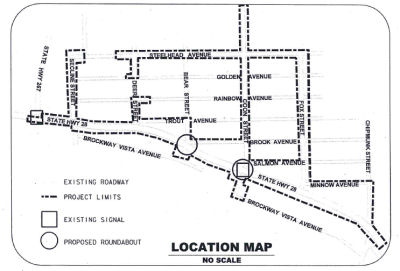 In 2007, the CTC did not
recommend using the Corridor Mobility Improvement Account to fund the
Kings Beach commercial core.
In 2007, the CTC did not
recommend using the Corridor Mobility Improvement Account to fund the
Kings Beach commercial core.
In June 2012, the CTC approved for future consideration of funding the Kings Beach Commercial Core Improvement Project (project) in Placer County, which will include roadway improvements to Route 28 to accommodate anticipated future transit and pedestrian needs which will include installing sidewalks; constructing curbs, gutters, storm drains, and water quality facilities at specific locations; streetscaping; designating specific road sites as on-street parking; and construction of new, off-street parking lots at specific locations within the action area in Placer County.
 Freeway
[SHC 253.1] Entire route. Added to the Freeway and Expressway system in 1959.
 Scenic Route
[SHC 263.1] Entire route: Route 89 in Tahoe City to Nevada State Line.
Although this segment is eligible for Scenic Highway status, it has not yet met the criteria to be officially designated as Scenic Highway.
 Interregional Route
[SHC 164.11] Entire route.
 Other WWW Links
 Statistics
Overall statistics for Route 28:
 Pre-1964 Legislative Route
The route that would become LRN 28 was first defined in the 1909 First Bond Act as running from Redding to Alturas. It was also part of the "Lassen State Highway" established in 1911 by Chapter 498 as follows:
"That certain highway known as the county road and beginning on the boundary line between Shasta and Lassen Counties in the NE corner of T37N R6E and running and extending through T38N R6E, T38N R7E, T38N R8E, to the Modoc County Line...shall be designated and known as the Lassen State Highway"
It was seemingly extended in 1915 when Chapter 765 authorized the survey, location, and construction of a route "from Surprise valley, in Modoc county, to the Nevada state line." However, this authorization was rescinded in the 1935 act that created the state highway code.
In 1921, it was more directly extended with Chapter 888, which provided an appropriation “...for the survey, plans and estimates and for the construction of the highway from the town of Alturas in Modoc county to the Nevada-California state line by the most direct and practical route via Cedarville in connecting with the proposed Nevada state highway...”
By 1935, the route had been codified into the highway code as running "from Redding to the Nevada line via Alturas and Cedarville". It was primary state highway from Redding to Alturus. The 1935 definition remained unchanged until the great renumbering in 1963. The entire route was signed as US 299 between Redding and US 395. The signage E of US 395 to the Nevada border before 1964 was unclear.
© 1996-2024 Daniel P. Faigin.
Maintained by: Daniel P. Faigin
<webmaster@cahighways.org>.
 Route 27
 Route 29