
 California Highways:
Click here for a key to the symbols used. An explanation of acronyms may be found at the bottom of the page.
 Routing
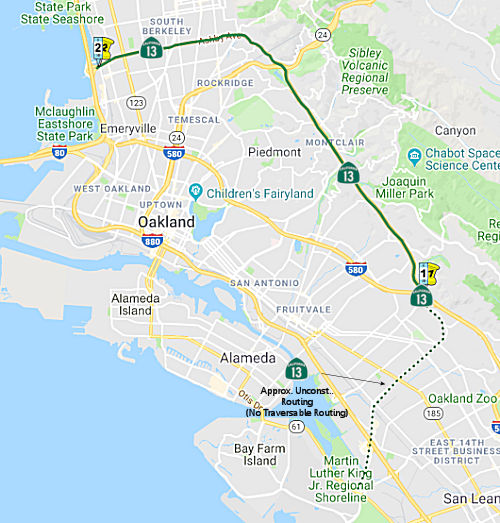 From Route 61
near the Oakland International Airport to Route 61 near Emeryville via the
vicinity of Lake Temescal.
From Route 61
near the Oakland International Airport to Route 61 near Emeryville via the
vicinity of Lake Temescal.
 Post 1964 Signage History
This route is as defined in 1963.
 Pre 1964 Signage History
 In 1934, Route 13 was signed along the route from Santa Cruz to
Jct. US 101 at San Rafael, via San Jose, Mt. Eden, and Oakland. This
corresponds to:
In 1934, Route 13 was signed along the route from Santa Cruz to
Jct. US 101 at San Rafael, via San Jose, Mt. Eden, and Oakland. This
corresponds to:
Multiple 1935 maps, however, show the route as Sign Route 17, so the renumbering happened quickly after the original designation in 1934. This is the route of present-day Route 17 to San Jose, I-880 between San Jose and Emeryville, and I-580 between Emeryville and San Rafael (although all of this was originally Route 17).
Post-1964 Route 13 / LRN 227
What became signed Route 13 in 1964 started out as three LRNs: part of LRN 258, LRN 227, and LRN 206. It does not appear that post-1964 Route 13 was signed as pre-1964 Sign Route 13:
The portion of unconstructed Route 13 between the current Route 61 routing along Doolittle Dr. (former LRN 226), starting about halfway between Jones Ave and Davis Street, and and I-580 (former US 50, LRN 5), was LRN 258 (added to the state highway system in 1959). Note that LRN 258 continued S from the junction of Doolittle Drive and Davis Street to Route 84 near Newark; this was planned to be an extension of Route 61, but was never constructed. Instead, Route 61 was signed along LRN 226 (Davis Street), which is legislatively Route 112.
The segment from I-580 (former US 50, LRN 5) to Route 24 (LRN 75, Sign Route 24) was LRN 227, defined in 1947. LRN 227 was assigned a sign route until 1964, and actually wasn't signed until the freeway was completed and opened in 1967.
The segment between Route 24 and former US 40 (today's I-80) was LRN 206, defined in 1935. This was originally signed as a continuation of Sign Route 24 (which entered Oakland through the Caldecott Tunnels along LRN 75). Sign Route 24, after passing through the tunnels and reaching Warren Blvd/Ashby Ave (LRN 227), turned to the NW and continued along LRN 206.
LRN 75 continued unsigned along Broadway MacArthur Blvd, US 50. In 1970, when the Route 24 freeway was completed to Route 17 (today's I-880) and replaced the Broadway routing, the LRN 75 segment between Route 24 and US 50 (today's I-580) became Route 24, and the LRN 206 segment between Route 24 and I-80 became Route 13.
In 1981, the Route 24 freeway between Route 17 and I-580 was renumbered as I-980, with Route 17 becoming I-880 in 1986. Why the renumbering to I-980? Likely, the reason was the same as the renumbering of I-238: To encourage truck traffic to avoid the truck-limited I-580 through Oakland; in this case, trucks on Route 17 (I-880) would follow I-980 through the Caldecott Tunnels or into Berkeley or Oakland, instead of taking I-580 through Oakland.
Lastly, between I-80 (former US 40) and present-day unconstructed Route 61 in Berkeley, the routing (unconstructed) was also LRN 206. This portion of LRN 206 was added to the state highway system in 1959. It is unsigned. Note that Route 61 was a planned freeway that paralleled I-80 near Berkeley, running along the edge of or slightly in the E edge of the bay going under the Bay Bridge, and then continuing E of Route 17/I-880 all the way S to Route 84 near Newark.
Between LRN 5 (Warren Blvd/US 50 (now I-580)) and Ashby Ave (Route 24, LRN 206), Route 13 was partially constructed as of 1963 (it was only constructed between Route 24 and Joaquin Miller Road). The routing of present Route 13 (then unsigned) was along Warren Blvd and then an unspecified routing (perhaps Mountain Blvd) to US 50 (LRN 5). This was LRN 227, added to the state highway system in 1947.
Unconstructed Portion
 Unconstructed for 4 miles from Route 61 to Route 580. This section
would have paralleled Hegenberger Road and 73rd Avenue.
However, no local roads adequately fit the definition of a traversable
highway. The 4.3 miles that were in the freeway and expressway system were
deleted effective 1/1/1982.
Unconstructed for 4 miles from Route 61 to Route 580. This section
would have paralleled Hegenberger Road and 73rd Avenue.
However, no local roads adequately fit the definition of a traversable
highway. The 4.3 miles that were in the freeway and expressway system were
deleted effective 1/1/1982.
The 2013 Traversable Highways report notes, for the two
segments from Route 61 to Route 580, and from Route 80 to Route 61: No
local roads adequately fit the description of a traversable highway. 4.3
miles were deleted from the F&E System effective 1/1/82. No
recommendation.
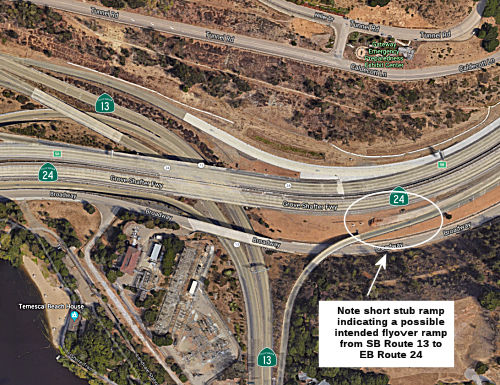
Sean Tongson notes that a short stub of concrete at the on-ramp from northbound Route 13 to eastbound Route 24 seems to suggest a possible flyover/under ramp may have been planned from southbound Route 13 to eastbound Route 24.
Construction Through Oakland
Construction for this freeway occurred mostly in the
late 1950s. By 1953, the first segment of LRN 227 was shown on state
highway maps as completed south of Route 24 to Moraga Avenue, following
Longvale Road and Mountain Boulevard. By 1955, LRN 227 was constructed for
1.3 miles between Thornhill Drive and Ascot Drive as a divided four lane
highway. Also, in 1955, $300,000 dollars budgeted by the State for the
1956-57 fiscal year towards the construction of LRN 227 between Route 24
and US 50 (future I-580). By 1958, state highway maps were showing
LRN 227 as completed just south of Joaquin Miller Road. The segment of the
Warren Boulevard Freeway from Broadway Terrace to Lincoln Avenue opened in
August 1958. By early 1960, LRN 227/Warren Boulevard Freeway was
completed from Broadway Terrace south to Redwood Road. The Route 13/Warren
Boulevard interchange at Moraga Avenue was completed on April 15, 1964.
The Warren Freeway was completed through Oakland in 1966, and completed to
I-580 (former US 50) by 1967, at which point it was signed as Route 13.
(Source: Gribblenation Blog (Tom Fearer), “California State Route 13 and the Warren Freeway”)
The Park Boulevard interchange was designed and designated as a future connection to the Shephard Canyon Freeway (then LRN 235, present-day unconstructed Route 77) through the Oakland Hills toward Moraga.
Constructed as freeway from I-580 to Route 24.
Route 13 in Berkeley
In Berkeley, Route 13 uses Tunnel Road and Ashby Avenue
to reach I-580. In 1935, the Berkeley Gazette reported, “Ashby
Avenue from the new low level tunnel to the East Shore Highway becomes a
part of the State Highway system today with the signature of Governor
Frank F. Merriam to Assembly Bill No. 641. The five and one quarter miles
of road is the only roadway in Northern California added to the State
Highway system this year. It is considered an extremely important addition
because it will be a main arterial connecting with the new San Francisco
Oakland Bay Bridge.” It was noted at the time that plans for the
improvement of Ashby Avenue called for an outlay of upward of $30,000 to
straighten out Ashby Avenue at Elmwood Court, just E of College Avenue.
(Source: East Bay Times, 7/15/2010)
In the 1930s, Ashby Avenue served as the only western
approach to Berkeley. In 1935, the opening of the Caldecott Tunnel
connected Berkeley to eastern towns, leading to a dramatic increase in
traffic along Ashby Avenue, particularly in the Elmwood district. Within
Elmwood, two sharp 90-degree turns, known as the Ashby Curve, became a
notorious bottleneck and safety hazard. The curve was widely regarded as
“one of the most dangerous and hazardous main thoroughfare curves in
the entire city. In 1941, the City of Berkeley purchased and moved six
homes to create a diagonal road to bypass the Ashby Curves. The
realignment significantly improved traffic flow on Ahsby into Berkeley,
helping to spur the development of the Elmwood business district. This
project also left behind a small sliver of land, on which a single house
remained.
(Source: Ashby Place Website, retrieved 1/17/2026)
The name of Ashby Avenue comes from the Ashby
brothers, Mark and William, who migrated to California in the first half
of the 1850s. Several years later, they purchased some 187 acres for a
ranch that was sustained by a tributary of Derby Creek. In 1876, when Mark
Ashby had become the title holder for the western portion of the property,
California’s former governor Leland Stanford and former Alameda
supervisor and real estate developer Francis Kittredge Shattuck succeeded
in connecting Oakland to Berkeley by purchasing a right-of-way for a steam
train spur line to travel from the main Central Pacific Railway up what is
now Stanford Avenue and Adeline Street, cutting through Mark Ashby’s
property and terminating at Shattuck and University avenues. The
Ashbys’ farming days were now numbered. In 1882, Mark Ashby filed a
property subdivision map for the Newbury Tract, so named for his hometown
of Newburyport, Massachusetts.
(Source: Berkeley Heritage, retrieved 1/17/2026)
 Status
Oakland Separation Barrier (04-ALA-13 PM 6.7/7.2)
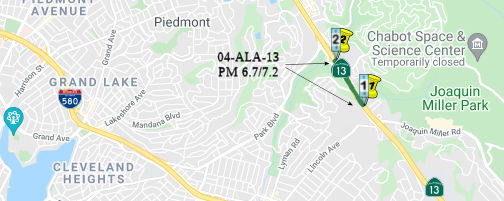 The 2020 SHOPP, approved in May 2020, included the following Collision Reduction item of
interest (carried over from the 2018 SHOPP): 04-ALA-13 PM 6.7/7.2 PPNO
1490P Proj ID 0415000356 EA 4J490. Route 13 in Oakland, from 0.2 mile
north of Lincoln Avenue to 0.2 mile south of Park Boulevard. Install outer
separation barrier and construct rumble strips. Programmed in FY21-22,
with construction starting 2/1/2023. Total project cost is $5,190K, with
$3,092K being capital (const and right of way) and $2,098K being support
(engineering, environmental, etc.),
The 2020 SHOPP, approved in May 2020, included the following Collision Reduction item of
interest (carried over from the 2018 SHOPP): 04-ALA-13 PM 6.7/7.2 PPNO
1490P Proj ID 0415000356 EA 4J490. Route 13 in Oakland, from 0.2 mile
north of Lincoln Avenue to 0.2 mile south of Park Boulevard. Install outer
separation barrier and construct rumble strips. Programmed in FY21-22,
with construction starting 2/1/2023. Total project cost is $5,190K, with
$3,092K being capital (const and right of way) and $2,098K being support
(engineering, environmental, etc.),
(Source: 2020 Approved SHOPP a/o May 2020)
In March 2021, the CTC approved the following
pre-construction support phase allocation(s): (2a) #7. $800,000 (PS&E,
$667,000 programmed); $42,000 (R/W Sup). 04-Ala-13 6.7/7.2. PPNO 04-1490P;
ProjID 0415000356; EA 4J490. Route 13 In Oakland, from 0.2 mile north of
Lincoln Avenue to 0.2 mile south of Park Boulevard. Install outer
separation barrier and construct rumble strips. Prog. year 20-21.
(Source: March 2021 CTC Agenda, Agenda Item
2.5b.(2a) #7)
In May 2021, the CTC amended this project in the
SHOPP: 04-Ala-13 6.7/7.2 PPNO 1490P ProjID 0415000356 EA 4J490.
Route 13 In Oakland, from 0.2 mile north of Lincoln Avenue to 0.2 mile
south of Park Boulevard. Install outer separation barrier, and
construct rumble strips. This was amended to adjust costs. During
PA&ED, additional tree removal, moment slab barrier, pavement and
excavation work were identified resulting in increased construction
support ($565K → $1,062K) and capital costs ($2,895K →
$5,344K). Revised total: $8,046K.
(Source: May 2021 CTC Agenda, Agenda Item 2.1a.(1d)
#9)
Park Blvd Overcrossing and Broadway Terrace Undercrossing Bridges (04-Alameda-13 7.4 /9.07)
In January 2024, Caltrans released the draft 2024
SHOPP, which contained the following project: 04-Alameda-13 7.4 /9.07.
PPNO 04-2910E; ProjID 0421000328; EA 3W230. Route 13 In Oakland, at Park
Boulevard Overcrossing Bridge № 33-0159 (Poor); also at Broadway
Terrace Undercrossing Bridge № 33-0162 (Fair). Seismic retrofit one
bridge and replace one bridge. Proposed ($ × 1000): PA&ED:
$1,620; PS&E: $3,610; R/W $60; R/W Sup $240; Con $23,348; Con Sup:
$6,130; Total: $35,008. Begin Con: 4/3/2028.
(Source: 2024 Draft SHOPP v4.0, 1/31/2024)
In May 2024, the CTC approved the following
preconstruction environmental phase allocation: $1,620,000 (PA&ED).
04-Alameda-13 7.4 /9.07. PPNO 04-2910E; ProjID 0421000328; EA 3W230. Route 13 In Oakland, at Park Boulevard Overcrossing Bridge № 33-0159
(Poor); also at Broadway Terrace Undercrossing Bridge № 33-0162
(Fair). Seismic retrofit one bridge and replace one bridge.
(Source: May 2024 CTC Agenda, Agenda Item 2.5b.(3) #29)
Bruns Court Pedestrian Overcrossing (~ ALA 7.859)
In September 2023, it was reported that the Bruns Court
Pedestrian Overcrossing (~ ALA 7.859), which allows people to walk over
Route 13 and Moraga Avenue from Bruns Court to Montclair Park, must be
replaced because it is seismically unsafe. The structure is especially
vulnerable to collapse because it lies about 200 feet from the Hayward
Fault. Locals use the bridge to get to the park to play baseball and
pickleball, or to walk their kids to Montclair Elementary School without
crossing Moraga Avenue, which has two driving lanes each way and features
many speeding cars. According to Caltrans records, the overcrossing is
also non-compliant with the Americans with Disabilities Act and has
inadequate vertical clearance on the freeway and residential roads under
it. The bridge has been in use since 1956. Caltrans says it plans to
build a replacement which will be completed by 2026. The state is
partnering with Oakland’s Department of Transportation to develop
the new bridge, as its elements may force the city to take on more
financial and right-of-way responsibilities. There are four options under
consideration to replace the overcrossing:
(Source: Oaklandside, 9/27/2023)
In January 2024, the following pre-construction-phase
SHOPP SB1 Project allocation was on the agenda, but was withdrawn:
$3,160,000. 04-Ala-13 7.9. PPNO 04-2020L; ProjID 0418000023; EA 0P890.
Route 13 In Oakland, at Bruns Drive Pedestrian Overcrossing №
33-0244 (PM 7.91). Replace pedestrian overcrossing and upgrade
seismic safety. Concurrent consideration of funding under Resolution
E-24-02; January 2024. Twenty month allocation time extension for
PS&E and R/W Sup approved under Waiver 22-73; June 2022. Programmed
(Allocation, if different): PS&E $2,584,000 ($3,050,000);
R/W Sup $93,000 ($110,000). Withdrawn
Prior to Meeting.
(Source: January 2024 CTC Agenda, Agenda Item 2.5b.(2b) #6)
In February 2024, it was reported that neighbors near
the Bruns Court overcrossing say the span should be replaced, and
they’re accusing the state highway agency, Caltrans, of not
listening to their needs and confusing residents. Residents are arguing
that Caltrans is pursuing the tear-down without a replacement option.
Under this plan, Caltrans and the city would make road improvements around
the nearby La Salle Avenue bridge, which currently has two vehicle lanes
and sidewalks. The improvements include new sidewalks, bike sharrows,
bulb-outs, and other car-slowing designs. Caltrans did not deny or confirm
its staff met with Oakland’s Mayor and OakDOT. But it confirmed the
La Salle Street option—which means tearing down and not replacing
the Bruns Court bridge—was the “selected alternative.”
According to Caltrans, the feedback they’ve gotten from Montclair
residents led them to the tear-down option. According to the state
agency’s outreach survey, 123 residents support demolishing the
Bruns Court footbridge and fixing up La Salle Avenue. Twenty-seven want
the La Salle Improvements while supporting “other street safety
improvements,” including replacing the footbridge with a new one,
and only 26 sought a pedestrian bridge replacement without changes to La
Salle. The difference in cost between tearing down the Bruns Court
crossing and fixing the La Salle Bridge versus replacing the Bruns Court
crossing with a new bridge has not been fully analyzed.
(Source: Oaklandside 2/14/2024)
Berkeley ADA Ramps
In May 2019, the CTC approved the following SHOPP
allocation: $4,373,000 (Const, Const Engr). Alameda 04-Ala-13 12.1/13.4.
Route 13 In Berkeley, from Shattuck Avenue to 7th Street. Outcome/Output:
Upgrade curb ramps and sidewalks to meet the Americans with Disabilities
Act (ADA) standards, install detectable warning surface, and restripe
crosswalks.
(Source: May 2019 CTC Minutes, Agenda Item 2.5b.(1)
Item 7)
In June 2019, the CTC approved the following SHOPP
scope amendments:
(Source: June 2019 CTC Minutes, Agenda Item
2.1a.(1) Scope Items 40, 41)
The 2020 SHOPP, approved in May 2020, included the ADA
Ramp Project (carried over from the 2018 SHOPP): 04-ALA-13 PM 10.7/13.0
PPNO 1490P Proj ID 0419000091 EA 2G461. Route 13 in Berkeley, from Domingo
Avenue to Mabel Street. Upgrade curb ramps and repair sidewalks to meet
Americans with Disabilities Act (ADA) standards. Programmed in
FY21-22, with construction starting 1/12/2023. Total project cost is
$6,095K, with $5,110K being capital (const and right of way) and $985K
being support (engineering, environmental, etc.),
(Source: 2020 Approved SHOPP a/o May 2020)
I-80/Ashby Avenue (Route 13) Interchange Improvements (04-Ala-13, PM 13.7/13.9)
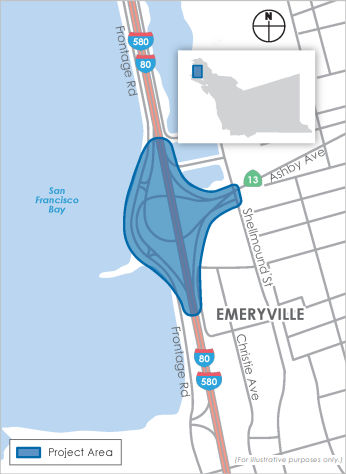 In June 2021, the CTC approved amending the STIP to use
the funding available through the 2021 Mid-Cycle STIP and share
distribution of the federal Coronavirus Response and Relief Supplemental
Appropriations Act of 2021 funds (COVID Relief Funds) to add a new project
to the STIP: Route 80 Ashby Interchange Improvements (PPNO 0069V); program
$50K to the PS&E phase in FY 2022-23.
In June 2021, the CTC approved amending the STIP to use
the funding available through the 2021 Mid-Cycle STIP and share
distribution of the federal Coronavirus Response and Relief Supplemental
Appropriations Act of 2021 funds (COVID Relief Funds) to add a new project
to the STIP: Route 80 Ashby Interchange Improvements (PPNO 0069V); program
$50K to the PS&E phase in FY 2022-23.
(Source: June 2021 CTC Agenda, Agenda Item
2.1a.(19); Image source: Project Fact Sheet from Alameda CTC)
This project proposes to reconstruct the I-80/ Ashby
Avenue interchange to improve accessibility, safety, traffic flow, and
bicycle and pedestrian facilities. These improvements are intended to
provide traffic congestion relief and enhanced mobility at this critical
access point and important intersection of regional transportation routes.
The project will also provide multimodal transport options, while
improving community connectedness, including connectivity to the existing
Bay Trail. This project was approved by Alameda County voters in 2014
under Measure BB and represents a direct investment in regional
infrastructure and economic development. It will provide a direct
connection between westbound I-80 and Emeryville by way of Shellmound
Street. Improvements will include:
(Source: Ashby Avenue Interchange Improvement Page, September 2021)
The estimated costs by phase ($ x 1,000) are:
PE/Environmental $4,500; Final Design (PS&E) $10,500;
Right-of-Way/Utility $4,400; Construction $137,600; Total Expenditures
$157,000.
(Source: Ashby Avenue Interchange Improvement Page, September 2021)
In January 2022, a few more details were reported. The
new bridges will provide vertical clearance along I-80 for freight
vehicles. The new interchange structure will supply better connections to
Shellmound Street, Frontage Road, and Point Emery. There will be a new
shared bicycle and pedestrian pathway to afford direct access to the San
Francisco Bay Trail. The project’s eastern end connects with a
concurrent development that should include raised, protected bike lanes on
part of Shellmound. However, that does not address the increased traffic
coming off the freeway where the ramps intersect.
(Source: Streetsblog SF, 1/13/2022)
In March 2024, the CTC approved for future
consideration of funding the following project for which a Mitigated
Negative Declaration (MND) has been completed: Interstate 80/Ashby
Avenue Interchange Improvement Project. (04-Ala-13, PM 13.7/13.9.
04-Ala-80, PM 3.9/5.0, PPNO 0069V) Route 13 and I-80 in Alameda
County. Provide interchange and local road improvements along I-80 at the
Ashby Avenue Interchange. The project would replace the existing
interchange connector ramps with a new bridge over I-80, realign access to
West Frontage Road, and add a new bicycle and pedestrian overcrossing, in
Alameda County. The project would replace the existing interchange
connector ramps with a new bridge over I-80, realign access to West
Frontage Road, and add a new bicycle and pedestrian overcrossing. The
project is currently programmed in the 2022 State Transportation
Improvement Program (STIP). The total programmed amount which includes
Right of Way (Capital), and Construction (Capital) is $117,200,000 from
STIP and Regional Improvement Program. Construction is estimated to begin
in Fiscal Year 2025-26. The scope, as described for the preferred
alternative, is consistent with the project scope as programmed by the
Commission in the 2022 STIP.
(Source: March 2024 CTC Agenda, Agenda Item 2.2c.(1))
In May 2024, the CTC approved the following allocation
for a Locally-Administered STIP Project on the State Highway System:
$50,000 (PS&E). 04-Ala-80 3.9/5.0. PPNO 04-0069V; ProjID 0418000225;
EA 25620. I-80/Ashby (SR-13) Interchange Improvements.
Reconstruct the I-80/Ashby Avenue (Route 13) Interchange and provide
bicycle/pedestrian connectivity. CEQA - MND, 12/28/2023. NEPA - FONSI,
12/28/2023. Future Consideration of funding approved under Resolution
E-24-13; March 2024. Time Extension for FY 22-23 PS&E expires on June
30, 2024. Contribution from other sources: $10,500,000.
(Source: May 2024,CTC Agenda, Agenda Item 2.5c.(2)/2.5v.(1))
The project page notes the remaining project schedule,
which includes the following major milestones and estimated time frames
associated with advancing Phase 1 project improvements: Right-of-Way
Certification – Spring 2026; Final Design – Fall 2026;
Construction – Spring 2026-Fall 2028
(Source: Project Page, retreived 1/17/2026)
 Naming
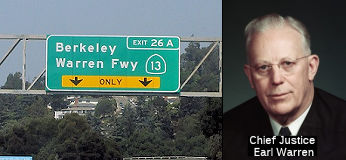 Route 13 from I-580 to Route 24 in Oakland (~ ALA 4.262 to ALA
R9.421) is named the "Warren Freeway". Earl Warren (March 19, 1891
– July 9, 1974) was an American politician and jurist who served as
the Governor of California from 1943 to 1953 and Chief Justice of the
United States from 1953 to 1969. The "Warren Court" presided over a major
shift in American constitutional jurisprudence, which has been recognized
by many as a "Constitutional Revolution" of the liberal, with Warren
writing the majority opinions in landmark cases such as Brown v. Board of
Education (1954), Reynolds v. Sims (1964), Miranda v. Arizona (1966) and
Loving v. Virginia (1967). Warren also led the Warren Commission, a
presidential commission that investigated the 1963 assassination of
President John F. Kennedy. He is the last Chief Justice to have served in
an elected office before entering the Supreme Court, and is generally
considered to be one of the most influential Supreme Court justices and
political leaders in the history of the United States. Warren was born in
1891 in Los Angeles and was raised in Bakersfield, California. After
graduating from the law program at the University of California, Berkeley,
he began a legal career in Oakland. He was hired as a deputy district
attorney for Alameda County in 1920 and was appointed district attorney in
1925. He emerged as a leader of the state Republican Party and won
election as the Attorney General of California in 1938. In that position,
he played a role in the forced removal and internment of over 100,000
Japanese Americans during World War II. In the 1942 California
gubernatorial election, Warren defeated incumbent Democratic governor
Culbert Olson. He would serve as Governor of California until 1953,
presiding over a period of major growth for the state. Named by Assembly
Concurrent Resolution 96, Chap. 166 in 1957.
Route 13 from I-580 to Route 24 in Oakland (~ ALA 4.262 to ALA
R9.421) is named the "Warren Freeway". Earl Warren (March 19, 1891
– July 9, 1974) was an American politician and jurist who served as
the Governor of California from 1943 to 1953 and Chief Justice of the
United States from 1953 to 1969. The "Warren Court" presided over a major
shift in American constitutional jurisprudence, which has been recognized
by many as a "Constitutional Revolution" of the liberal, with Warren
writing the majority opinions in landmark cases such as Brown v. Board of
Education (1954), Reynolds v. Sims (1964), Miranda v. Arizona (1966) and
Loving v. Virginia (1967). Warren also led the Warren Commission, a
presidential commission that investigated the 1963 assassination of
President John F. Kennedy. He is the last Chief Justice to have served in
an elected office before entering the Supreme Court, and is generally
considered to be one of the most influential Supreme Court justices and
political leaders in the history of the United States. Warren was born in
1891 in Los Angeles and was raised in Bakersfield, California. After
graduating from the law program at the University of California, Berkeley,
he began a legal career in Oakland. He was hired as a deputy district
attorney for Alameda County in 1920 and was appointed district attorney in
1925. He emerged as a leader of the state Republican Party and won
election as the Attorney General of California in 1938. In that position,
he played a role in the forced removal and internment of over 100,000
Japanese Americans during World War II. In the 1942 California
gubernatorial election, Warren defeated incumbent Democratic governor
Culbert Olson. He would serve as Governor of California until 1953,
presiding over a period of major growth for the state. Named by Assembly
Concurrent Resolution 96, Chap. 166 in 1957.
(Biographical information source: Wikipedia; Image sources: History.Com; Corco Highways)
This is also "Tunnel" Road and "Ashby" Avenue.
 Interstate Submissions
The portion from Route 580 to Route 24 was submitted for inclusion in the interstate system in 1945; it was not accepted.
The designation I-13 was proposed in November 1957 for what is now I-605. This was rejected by AASHTO. The I-605 routing was later proposed as I-105, before the number I-605 was chosen.
 Freeway
[SHC 253.2] From Route 61 near the Oakland International Airport to Route 24; from Route 80 to Route 61 near Emeryville. Constructed to freeway standards from Route 580 to Route 24. The entire route was added to the Freeway and Expressway system in 1959; the portion from Route 24 to Route 80 was deleted in 1981 by Chapter 292.
 Scenic Route
[SHC 263.3] From Route 24 to Route 580. Designated by Senate Bill 1036, Chaptered 7/21/2005, Chapter 101.
Although this segment is eligible for Scenic Highway status, it has not yet met the criteria to be officially designated as Scenic Highway.
 Classified Landcaped Freeway
The following segments are designated as Classified Landscaped Freeway:
| County | Route | Starting PM | Ending PM |
| Alameda | 13 | 5.29 | 5.57 |
| Alameda | 13 | 8.09 | 8.49 |
| Alameda | 13 | 9.05 | 9.50 |
 Exit Information
 Other WWW Links
 Statistics
Overall statistics for Route 13:
 Pre-1964 Legislative Route
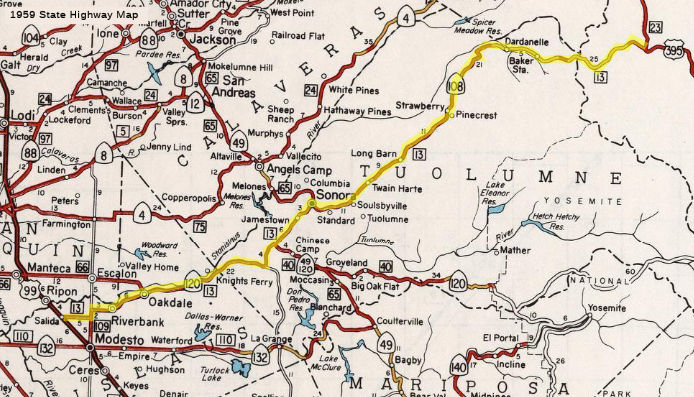 The route that would become LRN 13 was first defined in
Chapter 111 of the 1901 statutes: "That portion of the Sonora and Mono
wagon road, commencing E of Sonora and at a point commonly known as Long
Barn in Tuolumne Cty and running thence across the summit of the Sierra
Nevada mountains to Bridgeport in Mono County is hereby declared a state
highway." This route was also referenced by Chapter 150 in the 1905
statutes. It was first funded in the 1909 First Bond Act as a route "From
Salida to Sonora". In May 1919, Chapter 510 re-declared this routing to be
a state highway, "All that portion of the public highway commencing at the
end of the Sonora and Mono state highway at Long Barn in Tuolumne county
and leading therefrom to the eastern boundary of the city of Sonora and
known as the Sonora and Mono Road is hereby declared to be a state
highway...". Thus, in 1935, the routing was codified into the highway code
as:
The route that would become LRN 13 was first defined in
Chapter 111 of the 1901 statutes: "That portion of the Sonora and Mono
wagon road, commencing E of Sonora and at a point commonly known as Long
Barn in Tuolumne Cty and running thence across the summit of the Sierra
Nevada mountains to Bridgeport in Mono County is hereby declared a state
highway." This route was also referenced by Chapter 150 in the 1905
statutes. It was first funded in the 1909 First Bond Act as a route "From
Salida to Sonora". In May 1919, Chapter 510 re-declared this routing to be
a state highway, "All that portion of the public highway commencing at the
end of the Sonora and Mono state highway at Long Barn in Tuolumne county
and leading therefrom to the eastern boundary of the city of Sonora and
known as the Sonora and Mono Road is hereby declared to be a state
highway...". Thus, in 1935, the routing was codified into the highway code
as:
The portion from Salida to Sonora was considered a primary highway.
This route had the following pieces:
 Portions of this route between Route 99 and Yosemite
National Park were part of the National Park to Park Highway.
Portions of this route between Route 99 and Yosemite
National Park were part of the National Park to Park Highway.
© 1996-2024 Daniel P. Faigin.
Maintained by: Daniel P. Faigin
<webmaster@cahighways.org>.
 Route 12
 Route 14