
Telling a Story Through
Highway and Planning Maps
The History of Southern California Freeway
Development
(Part 1 — 1940s)
The freeway era in Southern California started with the construction of
the Arroyo Seco Parkway in 1940. This route, which was part of US 66, is
now the Pasadena Freeway, Route 110. Since the creation of the route,
regional planners have been working towards the goal of a comprehensive
regional freeway and expressway system.
Additional Resource Note:
Another good summary of Southern California transportation planning is
from the Metro Dorothy Payne Grey Transportation Library Primary Resources blog: a multi-part series titled "Past Visions of Los Angeles’
Transportation Future". It start in the 1920s, and then has followup pages on the 1930s and 1940s. There appear to be plans to extend the series, decade by decade, until the
2010s.
Freeway planning for the region started with the report "Freeways for the Region" from the Regional Planning Commission. This presented the original plan for a regional system of freeways. According
to the foreword of the report, the plan was developed "in fulfillment of
an order of the Los Angeles County Board of Supervisors, given on July 13,
1936." It talks about five routes as the nucleus of the plan (the
following is a quote from the report):
- The Arroyo Seco Parkway (1940) from Pasadena to
downtown Los Angeles, was the first unit completed between two major
centers of population in this region. Handling large volumes of
automobiles at high speed with a very low accident rate, it has already
justified the cost of construction. In 1941, the average daily flow of
automobiles over this six-mile parkway was 33,000 cars. The cost of
construction was $5,048,487 and the cost of the present work doubling
the facilities north of Castelar Street will be about $2,600,000.
- The Cahuenga Pass portion of a freeway through
Hollywood to San Fernando Valley (US 101) points has been completed for
about two years. Criticisms of this "freeway" are, in the long view,
unwarranted, for here we have merely a portion of a freeway, not in
itself complete. Preliminary detailed plans provide for extending this
project both northerly and southerly. Appropriations have already been
made for the extension northerly to Vineland Avenue, and $2,500,000 have
been budgeted for beginning work upon the section of Santa Monica and
Ramona Parkways from Vermont Avenue to Aliso Street. The present
mile-and-a-half section cost $1,707,000, and the extensions described
here are estimated to cost $12,875,000.
- Ramona Freeway (today's San Bernardino Freeway,
I-10) is now being built as a conversion of an existing highway. The
completion of the Aliso Street bridge across the Los Angeles River will
open a section of freeway from Vignes Street to Indiana Street in the
City of Los Angeles. Rights-of-way have been acquired and plans are
complete for the section east of Indiana Street. The ultimate length
will be thirty-one miles, to the City of Pomona, where connection with
freeways to be built in San Bernardino County will be made. The
twenty-five mile extension easterly from Indiana Street will cost
approximately $20,000,000.
- The Santa Ana Freeway, too, is partly under
construction. That portion which branches from Ramona Freeway, east of
the Los Angeles River, is being built as a part of the Ramona Freeway
interchange structure. The next section southeasterly, in Boyle Heights,
is now under construction in conjunction with development of the Pico
Gardens Housing Project. Land acquisition and plan preparation for the
remainder of its thirty miles to Santa Ana in Orange County are now
under way, at an estimated cost of $26,000,000.
- That section of the proposed Los Angeles River Freeway
south of Artesia Street (today's Long Beach Freeway, I-710) is
already advanced to the stage where approximately forty per cent of the
right-of-way within the City of Long Beach has been acquired. This
project will create a freeway from Ninth Street, Long Beach, northerly
to a temporary connection toward Los Angeles via Atlantic Boulevard.
The report identified the following additional projects:
- HOLLYWOOD PARKWAY (today's US 101) from Vermont Avenue to Highland
Avenue and from Vineland Avenue to Ventura Parkway.
- LOS ANGELES RIVER FREEWAY from Atlantic Drive to Santa Ana Freeway
(I-710) and from Arroyo Seco Parkway to Hollywood Parkway at Ventura
Parkway (I-5, Golden State).
- VENTURA PARKWAY from Hollywood Parkway to Sepulveda Parkway (US 101).
- OLYMPIC PARKWAY from Figueroa Parkway to Santa Ana Freeway (I-10 in
East LA).
- FIGUEROA PARKWAY from Castelar Street to Los Angeles Harbor (I-110, Harbor
Freeway).
- SEPULVEDA PARKWAY from Tunnel Station (Newhall Pass) to Orange County
boundary (I-405).
- INGLEWOOD PARKWAY from Figueroa Parkway to Sepulveda Parkway (roughly
I-105, but on a diagonal).
- SANTA MONICA PARKWAY from Hollywood Parkway to Sepulveda Parkway
(roughly the Beverly Hills Freeway).
![[Thumbnail: 1947 Freeway Plan]](maps/thumb-1947feplan.jpg)
(Click on image for the full size map. Full-size
image size: 174K.) |
| Figure 1-2. 1947 Master
Plan of Metropolitan Los Angeles Freeway adopted by the Regional
Planning Commission |
![[Thumbnail: 1949 ACSC Plan]](maps/thumb-1947-la-acsc.jpg)
(Click on image for the full size map. Full-size
image size: ~370K.) |
| Figure 1-3. 1949
Proposed Parkway Plan—Automobile Club of Southern
California (ACSC) |
![[1946 Parkway Map]](maps/1946-sc-parkway.jpg)
(Click on image for the full size map. Full-size
image size: ~880K.) |
| Figure 1-4. 1946 Proposed Parkway
Plan—Los Angeles |
Figure 1-1 shows the 1947 Master Plan as developed by the Regional
Planning Commission. Others also were preparing plans at this time; Figure
1-3 shows the proposed Parkway System developed by the Auto Club of
Southern California. There was also a complete 1946 Report: "Interregional, Regional, Metropolitan Parkways in the Los Angeles Metro Area" This plan (Figure 1-4) recognized the upcoming freeway system. The interstates were referred to as the "United
States Interregional Highway System", and included five Southern
California routes:
| Route No. |
Description |
Length |
Estd. Cost |
| 1 |
San Bernadino Parkway and portions of Riverside
Parkway and Los Angeles River Freeway |
26.1 mi |
$31,678,000 |
| 2 |
Ramona Parkway (excluding existing portions) |
29.4 mi |
27,800,000 |
| 3 |
Portions of Ventura (Riverside) Parkway and
Hollywood Parkway (excluding existing portions of the latter) |
39.0 mi |
66,366,000 |
| 4 |
Santa Ana Parkway |
12.8 mi |
14,650,000 |
| 9 |
Portion of Santa Monica Parkway |
11.0 mi |
25,500,000 |
| TOTALS...... |
118.3 mi |
$165,994,000 |
The State Regional System was also acknowledged. It noted of the routes
listed, 67 miles were included in the State Division of Highway's list of
critical parkway projects needed in the immediate future:
| Route No. |
Description |
Length |
Estd. Cost |
| 5 |
Sepulveda Parkway |
47.8 mi |
$53,453,000 |
| 6 |
Arroyo Seco-Harbor Parkway |
19.0 mi |
44,305,000 |
| 7 |
Portions of Inglewood Parkway |
6.0 mi |
16,508,000 |
| 8 |
Portions of Hollywood Parkway |
6.3 mi |
9,450,000 |
| 10 |
Portions of Slauson Parkway |
9.5 mi |
15,775,000 |
| 11 |
San Bernardino (Colorado) Freeway and portions of
Riverside Parkway |
41.9 mi |
60,480,000 |
| 12 |
Portion of Temescal Parkway |
4.0 mi |
4,000,000 |
| 13 |
Foothill Freeway |
28.5 mi |
32,500,000 |
| 14 |
Concord Parkway and portions of Los Angeles River
Freeway |
26.5 mi |
39,750,000 |
| 15 |
Portions of Olympic Parkway |
3.6 mi |
14,890,000 |
| 16 |
Portions of Pacific Coast Parkway |
12.0 mi |
19,200,000 |
| Totals..... |
205.1 mi |
$310,303,000 |
The 1946 Plan proposed the following local routes:
![[Table of Local Parkways]](images/1946-local-parkways.jpg)
As one can see, the plans were roughly similar, but had some distinct
differences. Some of the routes on these plans correspond to existant
highways today; some correspond to highways still on the books (as of
2000) but never constructed, and still others were only dreams of the
planners. Even when planned, not all routes were in the state system. Here
are some comments on how these plans compare to today's routes, as a
baseline (alphabetical order):
- Alamitos Parkway. North of I-405, this corresponds to the
unconstructed Route 47 freeway. South of I-405, it does not correspond
to any state highways.
- Allesandro Parkway. This corresponds to present-day Route 2
between US 101 and I-5.
- Appian Parkway: from Long Beach to the Orange County line
- Arroyo Seco Parkway. The first freeway, now the Pasadena
Freeway, Route 110.
- Artesia Parkway. Former US 91, now Route 91.
- Eaton Canyon Parkway. This corresponds to the unconstructed
Route 164.
- East By-Pass. This route was never constructed. It was still
on the state highway maps in 1963 (see LRN 222), and was briefly Route 241.
- Concord Parkway. The northern portion of this (i.e., N of
Pasadena) corresponds to the I-210. The portion S of Pasadena
corresponds to present-day I-710, the Long Beach Freeway
(including the unconstructed I-710 portion between I-10 and I-210).
- San Bernardino (Colorado) Freeway. No, this doesn't
correspond to the present-day San Bernardino Freeway. Rather,
this is the present-day Foothill Freeway, I-210. Note that, even
back in 1947, the route was planned to continue to San Bernardino (the
"new" I-210, "former" Route 30, portion)
- Olympic Parkway. This is close to present-day I-10, until the
merge with the Venice Parkway.
- Venice Parkway. Although Venice Blvd is Route 187, it was
never planned as freeway, so the parkway notion must have been a
regional planner's idea.
- Glendale Parkway. This corresponds to the present-day Route 2
freeway between I-5 and I-210.
- Harbor Parkway. This corresponds to the present-day Harbor
Freeway, I-110.
- Hollywood Parkway. This corresponds to the present-day
constructed portion of Route 170, and the portion of US 101 between the
Route 170/Route 134/US 101 merge and the I-5/US 101 merge.
- Inglewood Parkway. This was never constructed, and connected
with the Slauson Parkway. This was originally Route 90, and eventually
morphed into I-105.
- La Brea/Crenshaw Parkway. A parkway that would replace La
Brea Boulevard between Hollywood and Inglewood. For the most part, this
corresponds to the unconstructed portion of Route 170, which was
originally planned as freeway down Laurel Canyon, La Break, and
Crenshaw. The portion of this parkway between the Ventura Parkway
(US 101) and the Hollywood Parkway (Route 170) was not on the
state books.
- La Habra Parkway. This corresponds to a planned Route 39
freeway that was never constructed as such.
- Long Beach Freeway. This is the present-day Long Beach
Freeway.
- Los Angeles River Parkway. This corresponds to the portion of
I-5 in downtown Los Angeles.
- Los Coyotes Parkway. The correspondence of this route to a
present-day state highway is unknown, although portions might correspond
to Route 39.
- Manhattan Parkway. Connecting Manhattan Beach to the
Sepulveda Parkway (now I-405). Morphed into the plans for Route 107, but
was never constructed or added to the state highway system.
- Marina Parkway. This corresponds to the present-day
constructed portion of Route 90.
- Normandie Parkway. A Midtown north-south connector along
Normandie. This is another odd amalgam. Until it reaches the Harbor
Parkway, this plausably corresponds to present-day unconstructed
Route 258. However, Route 258 continued down to I-405, whereas this
parkway merges into the Harbor Parkway. What's interesting is
the 1963 map shows only the San Pedro to I-405 portion of Route 258 (LRN 291); the remainder, which shows on the 1996 map, appears not to have
been on the books.
- Ocean/Coast Parkway. This is a portion of the original
planned Route 1 freeway (which would also have continued N up the
coast).
- Pacific Parkway. This appears to correspond to Route 107.
- Rio Hondo Parkway. This was also part of the proposed Route 164 freeway.
- Riverside Parkway. Based on the position on the map, this
corresponds to present-day I-5.
- San Gabriel River Parkway. This is the present-day San
Gabriel River Freeway, I-605. It also includes what was originally
planned as Route 243.
- Santa Monica Parkway. This one is confusing. For some of the
route, it appears to correspond to the unbuilt Route 2 "Beverly Hills"
Freeway. However, the western portion might correspond to present-day
I-10. It appears that present-day I-10 was constructed between the Santa
Monica Parkway and the Olympic Parkway.
- Seaside Parkway. Present-day constructed Route 47.
- Sepulveda Parkway. This corresponded to pre-1964 Route 7, and
is present-day I-405.
- Slauson Parkway. The Slauson Parkway ran from the Inglewood
and Harbor Parkway (now Route 110) junction to the Santa Ana (Route 5)
and Rio Honda (Route 164) junction. The Metropolitan Planning Commission
had the route continuing to Yorba Linda. The roughly corresponds to
today's Route 90. Never constructed.
- Temescal Parkway. This corresponds to the present-day day
Route 57 (former I-210) freeway and Route 71 soon-to-be-freeway.
- Terminal Island Freeway. Present-day constructed Route 103,
although at one time part of Route 47. The route also shows some
unconstructed portions. Portions of this would have been the
"Industrial" freeway. The extension to the Long Beach Freeway was part
of planned LRN 231.
- Ventura Parkway. This is the present day Ventura Freeway,
US 101 and Route 134 between points west and Glendale.
- Whitnall Freeway. Across the San Fernando Valley from Burbank
to Chatsworth. This is still on the books as Route 64, but was never
constructed. Note that this route turns south after the Hollywood
Parkway and connects with the Normandie Parkway. There was also a
continuation of the route to the west, and then south along Malibu
Canyon, but this is not shown on the map.
Part 2 continues with how these routes morphed in the 1950s.
 Return to Stories and Maps Home
  Southern California Freeway Development - 1950s
© 1996-2020 Daniel P.
Faigin.
Maintained by: Daniel P. Faigin <webmaster@cahighways.org>.

 California Highways: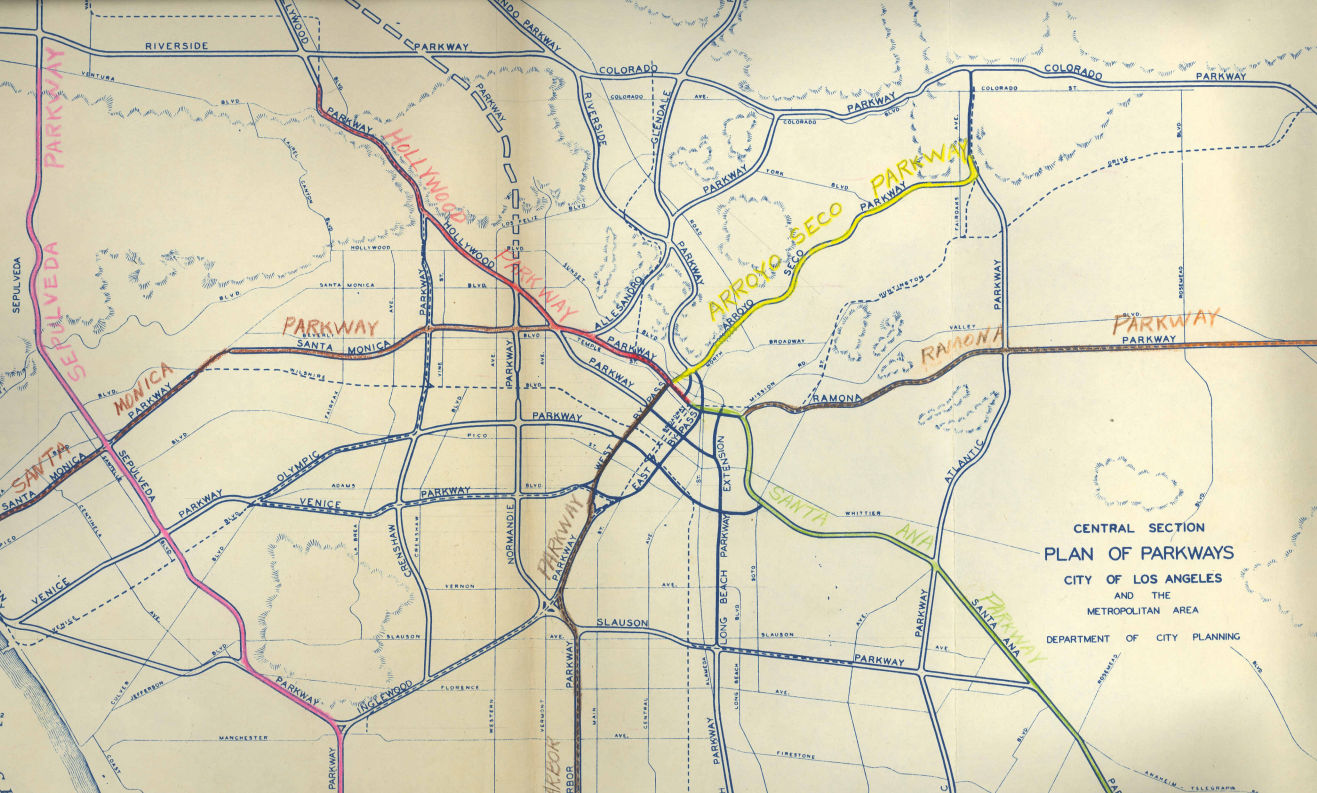
![[Thumbnail: 1947 Freeway Plan]](maps/1947feplan.jpg)
![[Thumbnail: 1949 ACSC Plan]](maps/1947-la-acsc.jpg)
![[1946 Parkway Map]](maps/1946-sc-parkway-big.jpg)