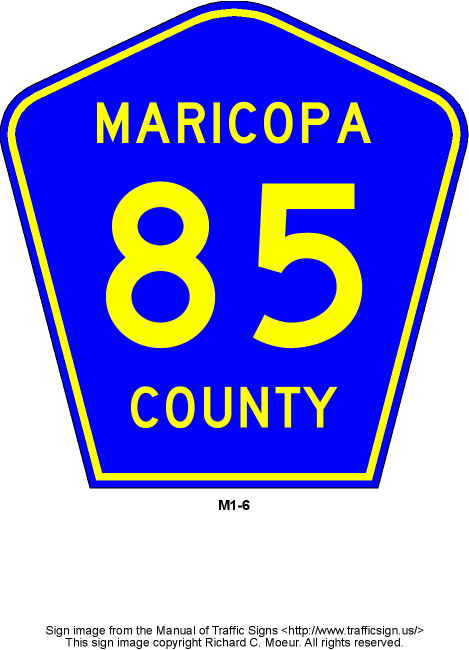
13-Point County Route Marker
Program
The following is the 13 point program adopted by NACO
for the signage of County Routes. It is almost identical to that adopted
by California in 1958. Statements have been translated from the legalese.
- A program of placing county route markers on certain county roads is
most desireable and beneficial to counties as well as to the traveling
public, and is a valuable service to the public.
- A program of placing county route markers should be implemented by
NACO.
- Route marking for county routes should conform to the "Purpose and
Policy in the Establishment and Development of United States Numbered
Highways" as adopted and revices by the American
Association of State Highway Officials (AASHTO), and the method of
installing such signs should follow the principles set forth in the "Manual on Uniform Traffic Control
Devices for Streets and Highways" published by the U.S. Bureau of
Public Roads in June 1961. This is now published by the Government
Printing Office (ISBN 999037533X), and is also available from ITE and in
CD-ROM format from ATSSA.
- The recommended
sign is a pentagon with rounded top corners, 18"x18" in size or
larger, with yellow letters, numerals and border on a blue background.
- Routes to be numbered should be sleected by the governing bodies of
the counties involved with a particular route by a proper resolution of
the body. In the event inter-county routes or routes into or through
incorporated cities are requested for numbering, resolutions from each
governing body involved must be on file before the number is assigned.
- Numbered routes must meet one of the following criteria:
- The route is a major road of general public interest, such
as qualified connections between state highways or county signed
routes.
- The route is a road leading to a major facility of a state park,
county park, national park or monument, or historical monument.
- The route is a road leading to a major publically owned recreation
area or to a major defense installation or area.
- The route is a major arterial street or road.
- Each state association must set up a board of review to administer and
monitor the program. In California, the board consists of 2 county
supervisors, 2 members of the County Engineers Council of California, 1
representative of the California State
Automobile Association (CSAA, Northern California AAA), 1
representative of the Automobile
Club of Southern California (ACSC, Southern California AAA), 1
staff member of CSAC, and the city-county cooperative projects engineer
of the Division of Highways.
- The individual state highway departments, through their state-aid
departments, act as the agency to select a numbering system, assigning
numbers, and maintaining the necessary permanent records.
- Numbers are assigned by the state highway departments only upon
receipt of the resolution of the Board and with the approval of the
Board of Review.
- The 13-point program are guides to be followed and may be amended for
individual state situations.
- Administration of the program is by the County
Supervisors Association of California (now the California
State Association of Counties).
- The program is voluntary.
- Upon approval and acceptance of the program, steps should be taken to
include the standard county route marker in the Manual on Uniform
Traffic Control Devices for Streets and Highways.
 Return to County Routes
Home
Return to County Routes
Home  Start
Visiting County Sign Routes
Start
Visiting County Sign Routes
© 1996-2020 Daniel P.
Faigin.
Maintained by: Daniel P.
Faigin <webmaster@cahighways.org>.
Last modified:

 California Highways: